Sunday, May 23, 2010

The Macdonald School of Design

"Contrary to modern architecture, where the line of play is clearly delineated by the designer, many of the classic courses left descisions on the ideal line of play entirely up to the individual.  Macdonald sought to make his course more than a simple objective test of skill, but strove to compose challenge that gave the game its essential subjective interest." -- George Bahto 

There, in a nutshell, is the essence of Macdonald's approach to golf architecture.  He didn't design courses that dictate what a golfer must do.  Strange to say, this big, blustery man with the big, blustery ego, a man who seems to have enjoyed telling others what to do, understood that the designer of a golf course had to stand back.  He couldn't bark orders.  He had to provide golfers the opportunity to make their own decisions about how to play a course.


Given how Macdonald began his quest to build an ideal course, this was by no means an inevitable conclusion.  His interest had been piqued by an article in a 1901 volume of Golf Illustrated which posed the question:  Which Are the Most Difficult Holes in the World?
Many leading players answered the question, and many holes that made the list are today regarded as iconic.  The Road hole, of course.  The Redan.  The Alps, the Long, the Eden.

Macdonald decided to use these tried-and-tested holes as his models, but the genius of his plan was to recognize that he needn't produce exact replicas.  The thrill of playing the Alps wasn't just hitting a ball over a high hill (though there is joy in it!).  No, the full satisfaction came from playing the hole successfully from tee to green, from choosing a method of attack and executing it as planned.

Macdonald and his associate/successor Seth Raynor built many courses that have become American classics, and they stuck to their repertory of holes.   If you just read the names of the holes that appear on many of their course -- Redan, Long, Road, Short, Punch Bowl, Short, Biarritz, Cape -- you could easily conclude that they didn't have much imagination.  They seemed to build the same hole over and over.


But when you actually see these holes, you realize how how much variation there can be from course to course.  Just look at the two shots of the Redans here.  Actually, since you can't see much in either of the pictures, I'll have to ask you to take me at my word. The top one is the Redan at the Chicago Golf Club, and the picture doesn't really do justice to the size of the green which stands high in its flat surroundings. This green looks like the roof of a house.The lower shot is of the Redan at National. Standing on the tee, you see just a sliver of green with the rest sloping away. They're both intimidating shots, but the Chicago Redan intimidates but showing you the wild slope of the green; the Redan at National intimidates by not revealing all of its dangers.

The Redan is probably the most frequently imitated hole in golf. For Macdonald's views on the hole, hit the link "Consider the Redan." And I can't resist adding that the hole was named for a fortress in Russia that was besieged by British forces during the Crimean War. Manned by Russian artillery, the "Great Redan" acquired a reputation as an impregnable fortification. The image at the right is from the Museum at Sebastopol.

Thursday, May 20, 2010

The Lido

"Lido is the finest course in the world.  It is a standing miracle, the wonder of which will never fade." -- Bernard Darwin

After the success of the first three courses at Bandon Dunes, Mike Keiser knew hat he wanted to build a fourth course,  and his first idea was to reconstruct the Lido, a long-lost Macdonald masterpiece and the most famous of America's lost course.
The Lido was built at staggering expense on Long Island, where Macdonald dredged 2,000,000 cubic yards of sand to fill in a marshy site.  The rough was created by hand-planting 1,000,000 bents, rushes, and eel grass plants.  Several holes were built around a lagoon, and the overall result was a course that rivaled the National.  
When he read The Evangelist of Golf,  Mike was so smitten with the story of the Lido that he called author George Bahto.  He asked if George thought it would be possible to recreate the Lido.  He said that he had a piece of property in Oregon and would like George to come out and take a look at it to see it would be a suitable site for the Lido.

It didn't take George long to say yes.  He was thrilled with the opportunity, and on his trip to Bandon Dunes he drew up a routing plan.   When Mike talked to his golfing friends and advisors, he tried the idea out on them.  To his surprise, they weren't as fired up about the idea of resurrecting the Lido as he was.  They thought it would turn out to be just a novelty or curiosity, another replica course -- one with a twist, admittedly, since the Lido would be a replica of a course that no longer existed.
A new idea began to take shape -- a course that would be a tribute to Macdonald.  The holes wouldn't be slavish reproductions of the holes he built at the National and elsewhere, but contemporary versions that employed his design concepts and principles.  As the concept evolved, many of the key conversations were between Mike and Tom Doak.  What's the difference between a replica and tribute course?  Mike has found a way to state it in mathematical terms:  his formula is that replica holes are 98 per cent the same as the original, and holes "inspired by" are in the raged of 5-25 percent the same.  He says that "holes inspired by are sisters, brothers, cousins, and distant cousins."
For a full story of the rise and fall of the Lido, take a look at Bahto's account in The Evangelist of Golf (there's a link on the left where you can read about the book -- buy it!).  There's also a link to an article about the Lido by Macdonald himself, and it's free.
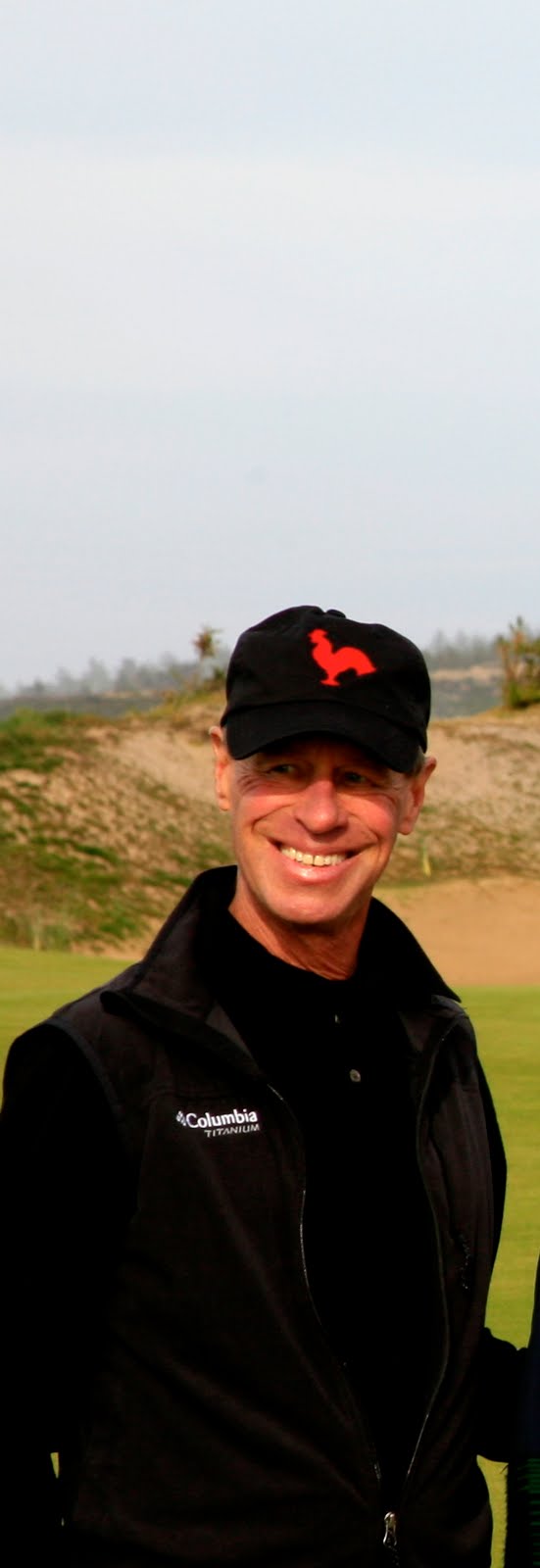
That's George Bahto in the photograph with Mike Keiser, on the Old Macdonald site during construction.  Photo below shows the Hell bunker on Old Macdonald No. 6


Wednesday, May 19, 2010

How Old Macdonald Got Its Name


Mike Keiser cares about names.  At the company he founded, Recycled Paper Greetings, he selected thousands of greeting cards, and he understood the importance of hooking people right away.  
The process of naming the other courses at Bandon Dunes had been long and drawn-out, with lots of candidates for each course.  But this name -- Old Macdonald -- had immediately sprung to mind, thanks to the children's song with the funny barnyard noises.  A more grandiose name might have given the impression that this tribute course was a museum piece, a dull lesson in the history of golf architecture.  But Old Macdonald was playful and irreverent.  It sprinkled a dash of irony on the idea of a tribute.  It was different.  It was a name that could make a golfer curious, and that was exactly what Mike was aiming for.
The name had taken care of itself, but the logo had proven tricky.  Two designs emerged as finalists, and they were as different as a rose from a rooster.  Actually, one was a rooster that looked like a weathervane rooster, proud and brash, flaunting its fantail.  The other, more traditional design consisted of a round O encircling an M whose diagonal lines were golf clubs.
Mike himself seemed to prefer the rooster, but Brad Klein, one of the design consultants, thought it was silly.  When he saw the rooster logo on a hat, he said it looked as though you ought to be able to push the rooster to play the song.
To settle the matter, visitors to Bandon Dunes pro shop were asked to choose between the two logos.  The rooster lost.

The Old Man Himself


"Variety is not only the 'spice of life' but it is the very foundation of golfing architecture." --
Charles Blair Macdonald

Old Macdonald, the fourth course at Bandon Dunes, pays tribute to Charles Blair Macdonald, who was not only present at the creation of American golf but was a leading actor in the story.  In 1895, he won the first Amateur Championship sanctioned by the United States Golf Association -- at the time a brand new organization that he had helped to found.   He laid out the first 18-hole golf course in the country, and he poured his enormous energy and talent into the creation on the National Golf Links, on Long Island.  His declared purpose was to build a "classical golf course in America, one which would eventually compare favorably with the championship links abroad and serve as an incentive to the elevation of the game in America."

Charlie Macdonald had a big ego, a big vision, and a big talent.  He went abroad to study and map what he considered ideal holes, and after locating an ideal site adjacent to Shinnecock Hills (after failing in his effort to purchase that club), he built his version of those holes, adapting, combining, rearranging, and sometimes inventing features to suit his purpose.  When the course opened for limited play in 1910, it was immediately recognized as one of the best courses anywhere -- a course that was as grand as Macdonald had promised.

And the National did spark the development of golf course design in America; it marked the beginning of what we now think of as the Golden Age.  As the decades passed, Macdonald's reputation lagged behind while other architects, like Donald Ross and A. W. Tillinghast, were rediscovered and lionized.  The explanation seems simple enough -- Macdonald built fewer courses than they did, and some of his finest courses, notably the Lido, have vanished (I'll talk about the Lido in my next post -- meantime, try to imagine the reputation of Donald Ross if Pinehurst No. 2 had disappeared).  Further, his courses were ultra-private and didn't regularly host high-profile events.   (The only Macdonald course open to the public is the Old White course at the Greenbrier, recently renovated by architect Lester George and slated to host a PGA Tour event, The Greenbrier Classic).

In the last ten years, though, there's been a revival of interest in Macdonald.  George Bahto's book, The Evangelist of Golf,  is a feast for golf architecture junkies -- and for anyone who likes a bushy golf tale. 
George, by the way, was one of the design consultants for Old Macdonald . . . more on that later.  Macdonald was inducted into the World Golf Hall of Fame in 2007, and a brief version of his career is available on that site.

I've had a chance to play several Macdonald courses, and I have indelible memories of my first visit to the National.  Around the second hole, Sahara, where the blind tee shot has to be played over a huge sandy waste, I felt my face stretching into a big grin, and the grin remained long after the round.  The National may be getting on in years, but it's still more fun than just about any course on the planet.

Monday, May 17, 2010

Met Golfer Excerpt


If you want a preview of the book, hit the link on the right for Met Golfer.  Several pages from the book are included in the April/May issue, along with several of Wood's photos.  Just to whet your appetite, for the book and for the golf course, I'm including another shot of No. 7.

You'll notice first that marvelous sky that looks as though the heavens are about to make an announcement, but -- if you're thinking of playing Old Macdonald -- take note too of that bunker behind the green.  It was placed there to keep balls from rolling down toward the beach, and it is perfectly located to catch the weakly hit balls swatted down by the wind.

Book Cover


I hope it's true that a book is judged by its cover because the cover of Dream Golf is a stunning photograph of the 7th hole at Old Macdonald.

The 7th hole is one of the only seaside holes at Old Mac, and one of the most dramatic.   It didn't appear on any of the original routing plans, which had the seventh green located at the foot of the ridge.  Mike Keiser wanted to locate a turnstand at the top of the ridge to provide golfers with a view of the Pacific.  During a walk-around, he and Tom Doak walked up to the top of the ridge.  

It was a Eureka moment.  Within half an hour, the decision had been made to move the 7th green to the top of the ridge.   The oceanside 7th is one of the most photogenic holes on the course, and one of the most challenging.  In the prevailing northerly wind, the approach shot to this green is like trying to land a ball on a magic carpet as it flies by.

The photograph was taken by Wood Sabold, a Bandon resident who has been taking pictures of Bandon Dunes since the earliest construction.  Wood is a fine art photographer and many beautiful images of the Pacific Northwest -- including the majestic rock formations, or sea stacks -- are posted on his website at http://www.woodsabold.com/